With the rapid development of flexible electronics, compute-in-memory technology, and electronic devices for extreme environments, traditional inorganic memory devices are increasingly revealing their limitations in terms of flexibility, low-cost fabrication, and structural designability. Organic polymer-based memory devices, with their advantages of light weight, flexibility, solution-processability, and controllable molecular structure, have become a research hotspot for next-generation non-volatile memory. Among these, polyimide (PI), with its excellent thermal stability, chemical stability, high dielectric strength, and mechanical flexibility, has emerged as the core functional material with the greatest application potential in the field of organic electronic memory. It is widely used in various types of polymer memory devices, including resistive and transistor-based devices.
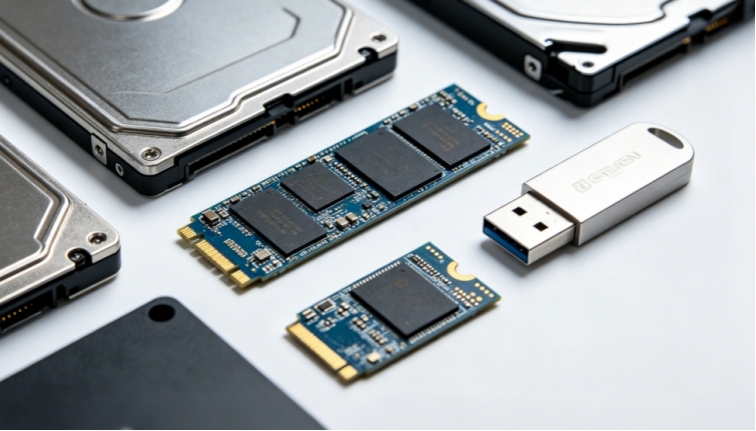
Polymer-based memory devices can be broadly categorized into two main types: resistive and transistor-based. Resistive memory devices feature a simple structure, employing a “electrode/functional layer/electrode” sandwich architecture. They store information by reversibly switching the resistance of the functional layer under the influence of an electric field, and can be further classified into non-volatile and volatile types. Non-volatile storage includes write-once-read-many-times (WORM) types and rewritable flash memory types, which are the current focus of research; volatile storage loses data immediately upon power loss and is primarily used for temporary data processing. Transistor-based storage is based on organic field-effect transistors (OFETs), utilizing charge trapping effects to modulate the threshold voltage for data storage, and offers higher integration. Among numerous polymer materials, polyimide can simultaneously serve as a resistive switching layer, an insulating dielectric layer, and a flexible substrate, making it suitable for all types of polymer memory devices. Its comprehensive performance far exceeds that of ordinary conjugated polymers and insulating polymer materials.
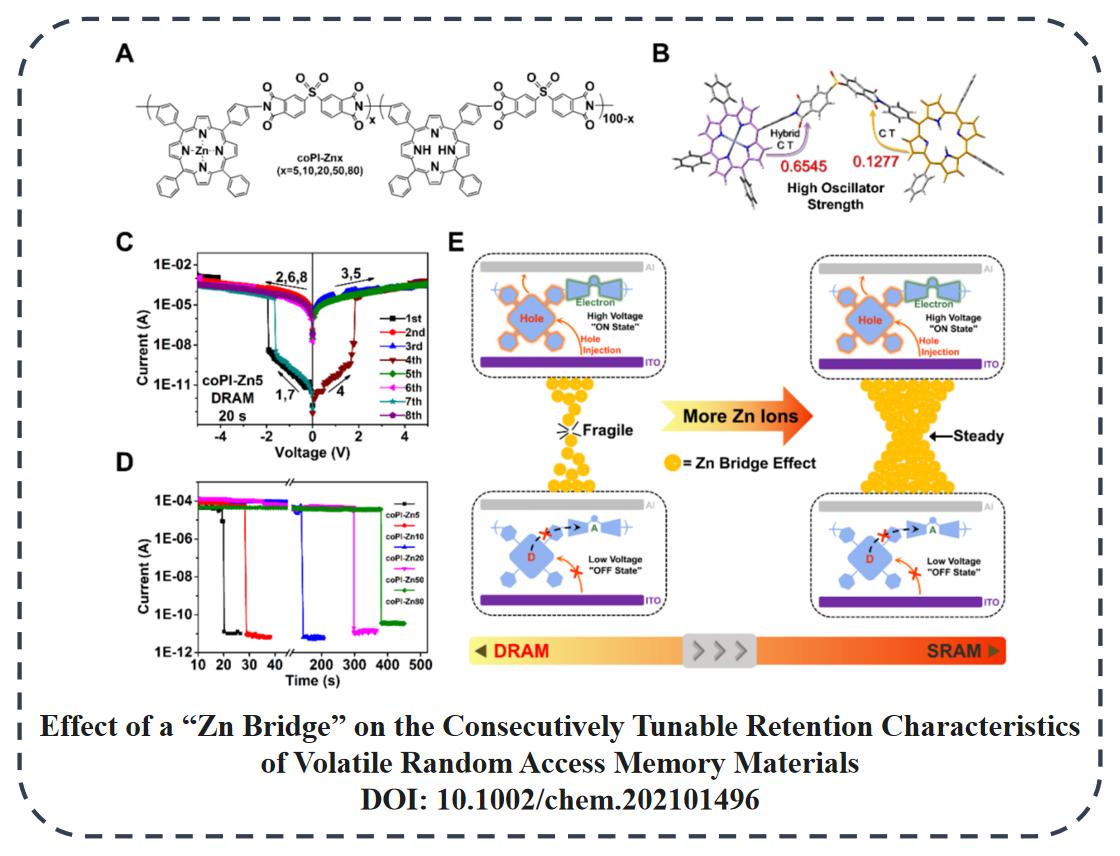
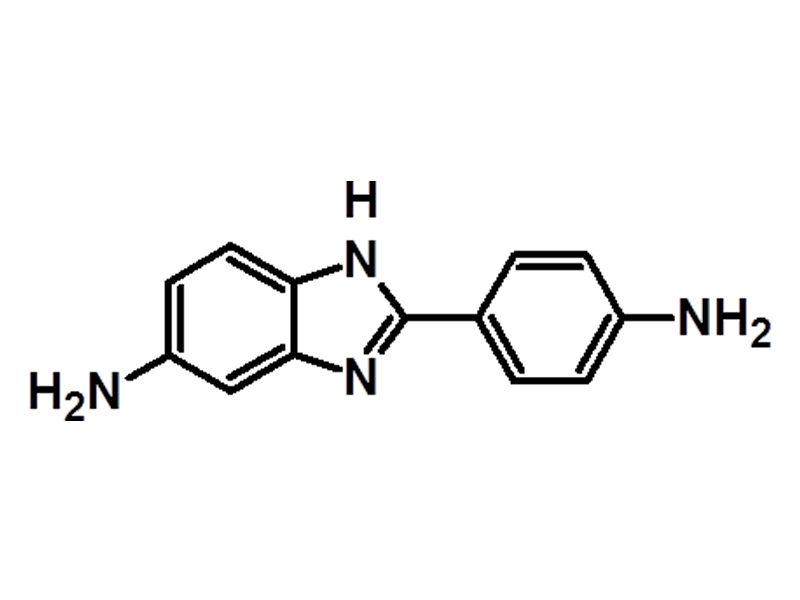
The main chain of polyimide molecules contains rigid imide rings and aromatic structures, endowing the material with ultra-high thermal stability, aging resistance, and low leakage characteristics. Additionally, through molecular design, donor-acceptor groups and redox-active units can be introduced to precisely regulate charge transport and resistive switching behavior. In resistive organic memory devices, modified polyimide serves as the core resistive switching material, with its storage mechanisms primarily involving three processes: intramolecular charge transfer, charge trapping and release, and reversible redox reactions. By introducing functional units such as triphenylamine, benzimidazole, and carbazole into the PI backbone to construct a D-A charge transfer system, intermolecular charge separation and migration occur under an electric field, forming a stable conductive pathway and enabling rapid switching between high-resistance and low-resistance states. Concurrently, intrinsic defects and doping sites within the polyimide serve as charge traps, regulating resistance through the capture and release of charge carriers, thereby ensuring the stability of the storage state.
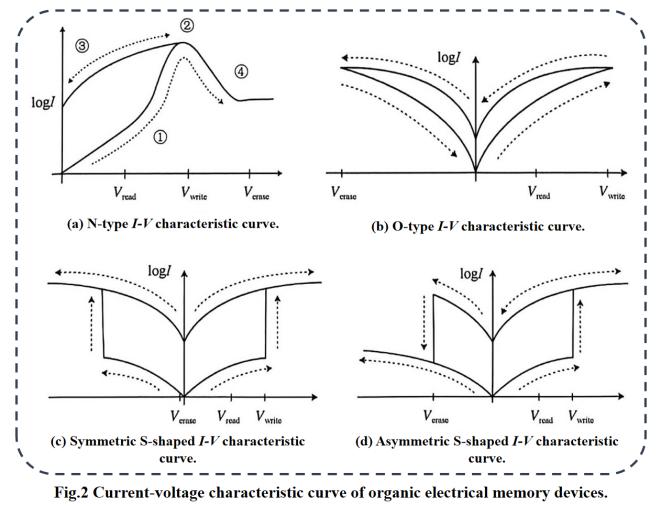
Electrical characterization is crucial for evaluating the performance of polyimide memory devices. Device current-voltage (I-V) curves are primarily classified into three types: N-type, O-type, and S-type. The N-type curve is a typical characteristic of pure polyimide devices, featuring a steep switching response, a clear hysteresis loop, rapid switching between high- and low-resistance states, a switching ratio of 103 to 106, and excellent repeatability and stability, making it suitable for high-precision digital storage. The O-type curve features a wide hysteresis loop and a smooth transition process. It is commonly observed in doped and modified polyimide materials, where the synergistic effect of ion migration and interfacial barriers results in a gradual resistance change, offering the potential for multi-level storage. The S-type curve exhibits a distinct negative differential resistance effect, with current exhibiting a fluctuating rise-and-fall pattern. This is primarily related to thermal effects and charge avalanche effects under strong electric fields and is commonly observed in thick-film and highly doped polyimide memory devices. The differences among these three types of curves also provide a crucial basis for the targeted design of PI-based memory device performance.
Compared to other organic storage materials, polyimide-based storage devices offer distinct advantages. First, they exhibit excellent high-temperature resistance, capable of stable operation in environments ranging from 150 to 200oC, making them suitable for extreme conditions such as aerospace and industrial measurement and control applications; Second, they possess good mechanical flexibility, allowing for the fabrication of ultra-thin flexible films suitable for foldable and wearable electronic devices; third, they exhibit strong chemical stability, with resistance to moisture and oxidation, effectively addressing the weakness of poor environmental tolerance in organic devices; fourth, their synthesis processes are mature, enabling large-area fabrication via solution-based methods such as spin coating and inkjet printing, thereby reducing device production costs. Currently, polyimide-based memory devices have achieved diversified development in binary, multi-level, and synaptic neuromorphic storage, demonstrating broad prospects in the fields of compute-in-memory and neuromorphic computing.
At present, the development of polyimide memory devices still faces challenges such as insufficient device uniformity, difficulties in large-scale array fabrication, and poor stability in multi-level storage. Future industry and materials research will focus on three major directions: First, precise molecular modification to optimize the PI conjugated structure and functional group ratios, further enhancing switching lifetime, read/write speeds, and environmental stability; Second, organic-inorganic composite modification, integrating carbon materials, two-dimensional nanomaterials, and metal oxides to synergistically optimize conductive mechanisms and resistive switching performance; third, process integration and innovation, developing high-precision printing and micro-nanofabrication technologies to drive the industrialization of flexible, high-density storage arrays.
In summary, thanks to its unique structural advantages and tunable electrical properties, polyimide has overcome the performance limitations of traditional organic storage materials and has become the core supporting material for polymer-based storage devices. With continuous innovations in molecular design, composite modification, and fabrication processes, polyimide-based organic storage devices will achieve large-scale applications in fields such as flexible electronics, high-temperature specialty storage, and artificial intelligence storage-computing integration, laying a crucial foundation for the development of next-generation low-cost, multifunctional, and highly reliable storage technologies.
HEYNOVA
an excellent service provider of key new materials and overall solutions for the global high-tech industry, focusing on the R&D and production of Polyimide monomer, Photoresist monomer & PAG, OLED monomer, Lithium battery materials, and customized services.


 English
 Nederland


![N-[4-[4-[(1,3-Dioxo-2-Benzofuran-5-Carbonyl)amino]-2-(Trifluoromethyl)phenyl]-3-(Trifluoromethyl)phenyl]-1,3-Dioxo-2-Benzofuran-5-Carboxamide (TA-TFMB ) 1226511-56-3 C32H14F6N2O8](/uploads/image/20250707/1226511-56-3-ta-tfmb-china.webp "N-[4-[4-[(1,3-Dioxo-2-Benzofuran-5-Carbonyl)amino]-2-(Trifluoromethyl)phenyl]-3-(Trifluoromethyl)phenyl]-1,3-Dioxo-2-Benzofuran-5-Carboxamide (TA-TFMB ) 1226511-56-3 C32H14F6N2O8")
![7-(4,4,5,5-Tetramethyl-1,3,2-Dioxaborolan-2-Yl)-Spiro[9h-Fluorene-9,9′-[9h]xanthene]-2-Carbonitrile 2259843-44-0 C32H26BNO3](/uploads/image/20250711/2259843-44-0-china.webp "7-(4,4,5,5-Tetramethyl-1,3,2-Dioxaborolan-2-Yl)-Spiro[9h-Fluorene-9,9′-[9h]xanthene]-2-Carbonitrile 2259843-44-0 C32H26BNO3")
-new-material-technology-co.,-ltd.-wechat.webp)