Copolymerized polyimide (Co-PI) refers to a class of polymeric copolymers synthesized via condensation polymerization using two or more dianhydride monomers with different structures and/or two or more diamine monomers with different structures, characterized by a main chain containing imide rings (-CO-N-CO-). Compared to homopolymer PI, which is synthesized from a single dianhydride and a single diamine, the core advantage of Co-PI lies in its “designable molecular structure.” By controlling the types of monomers, their ratios, and the copolymerization method, rigid segments, flexible segments, and functional groups can be synergistically introduced into the molecular chain, breaking the regularity of homopolymer chains and enabling customized control of performance.
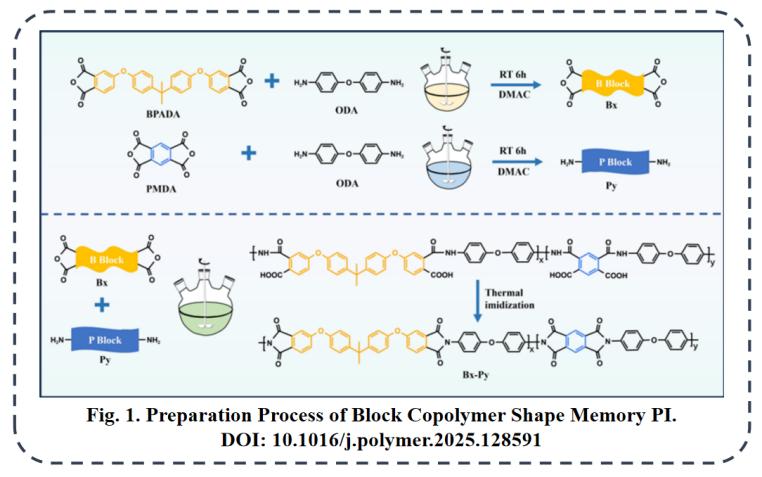
From a structural classification perspective, Co-PI can be divided into binary copolymers and multi-component copolymers (terpolymers and above) based on the number of monomers: binary copolymers serve as the basic form, using a combination of two monomers to initially improve the processability or toughness of homopolymer PI; multi-component copolymers are the mainstream choice for high-end applications, as the synergistic effects of three or more monomers can simultaneously meet various performance requirements, such as heat resistance, low dielectric constant, high transparency, and melt processability. Based on chain structure, Co-PI can be classified into random copolymers, alternating copolymers, block copolymers, and graft copolymers. Among these, random copolymers are the most commonly used in industrial production due to their simple synthesis and uniform properties; block copolymers, through the combination of rigid and flexible segments, offer both high strength and high toughness, making them suitable for high-end structural components. This article details the methods for regulating Co-PI properties as follows:
The monomer structure is the key factor determining the upper limit of Co-PI performance, and the synergistic interaction of different monomer types enables targeted performance control. Rigid monomers can enhance the material’s Tg, thermal stability, modulus, and dimensional stability while reducing CTE; flexible monomers improve the material’s solubility and toughness by introducing flexible chain segments such as ether bonds and sulfonyl groups, lower the melting temperature, and enable melt processing; Functional monomers can impart special properties to the material; fluorinated monomers can reduce the dielectric constant and water absorption while improving transparency, and hydroxyl-containing monomers can enhance adhesion and cross-linking capacity.
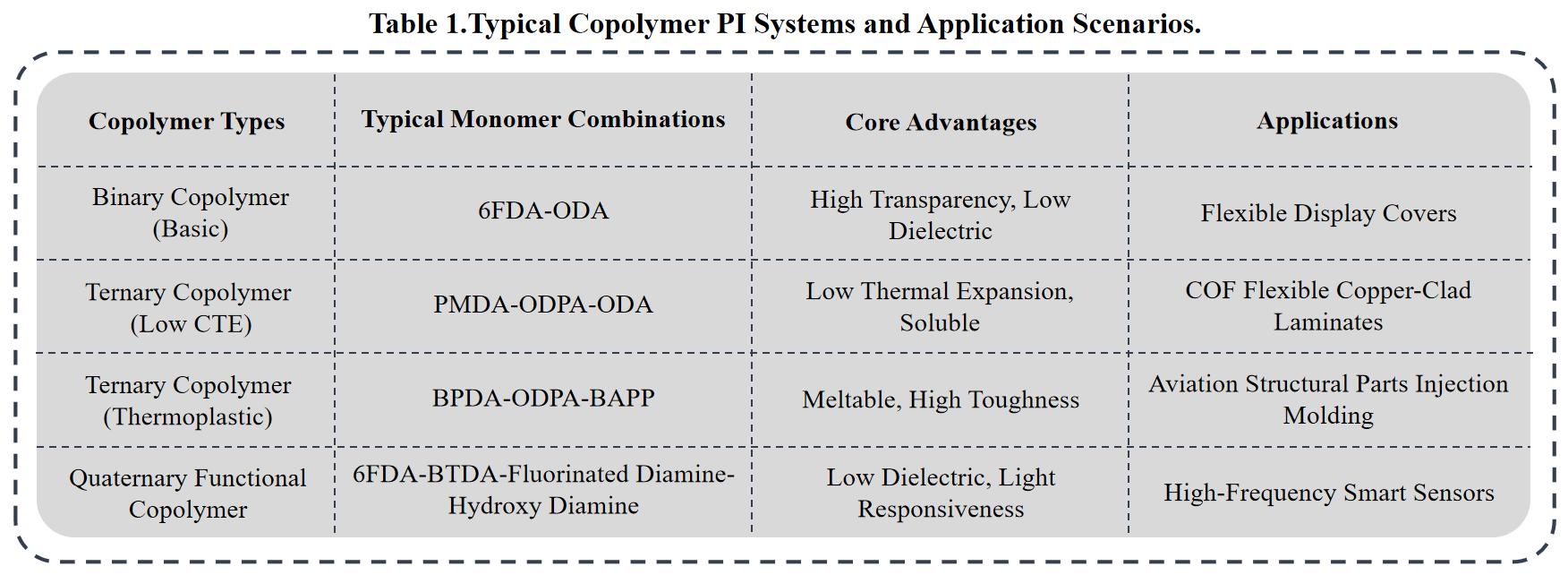
The monomer ratio serves as a “lever” for performance control; by adjusting the proportions of rigid, flexible, and functional units, it is possible to achieve a balanced optimization of performance. Increasing the proportion of rigid units enhances heat resistance and dimensional stability but reduces solubility and processability; increasing the proportion of flexible units improves processability and toughness but sacrifices some heat resistance; increasing the proportion of functional units (such as fluorinated monomers) enhances specific properties (such as low dielectric constant and high transparency), but requires balancing cost and mechanical properties.
Different copolymerization methods can alter the arrangement of molecular chains, thereby regulating properties. In random copolymers, monomers are randomly distributed; these offer uniform properties and simple synthesis, making them suitable for industrial-scale production. In block copolymers, the molecular chain structure is regular, providing higher heat resistance and modulus, but synthesis is more difficult, making them suitable for high-end structural materials; Block copolymerization, through the segmented polymerization of rigid and flexible segments, can simultaneously retain the heat resistance of the rigid segments and the processability of the flexible segments, combining high strength with high toughness; graft copolymerization, by introducing functional groups (such as photosensitive groups or siloxane segments) into the side chains of the molecular chains, enables special functions such as surface modification and photoresponsiveness.
Optimizing process parameters can further enhance the performance stability of Co-PI. In thermal imidization, a too-slow temperature ramp-up rate extends the production cycle, while a too-fast rate leads to incomplete imidization; residual amides reduce the material’s heat resistance and mechanical properties; In chemical imidation, the ratio of dehydrating agent to catalyst must be precisely controlled to prevent residual catalyst from affecting the material’s electrical properties.
To meet the demands of specialized fields, the performance of Co-PI can be further enhanced through functionalization or inorganic nano-hybridization. Functionalization involves introducing photosensitive groups, sulfonic acid groups, and other functional groups to enable photolithography, proton conduction, and other functions, making the material suitable for optoelectronic devices, fuel cells, and other fields; inorganic nano-hybridization involves adding nanoparticles such as nano-SiO2, graphene, and BN to enhance the material’s modulus, heat resistance, and barrier properties, while reducing CTE, making it suitable for the stringent requirements of aerospace, high-end electronics, and other fields.

HEYNOVA
an excellent service provider of key new materials and overall solutions for the global high-tech industry, focusing on the R&D and production of Polyimide monomer, Photoresist monomer & PAG, OLED monomer, Lithium battery materials, and customized services.


 English
 Nederland


![6-(4-Aminophenoxy)-[1,1'-biphenyl]-3-amine 1215223-23-6 C18H16N2O](/uploads/image/20251022/1215223-23-6-china.webp "6-(4-Aminophenoxy)-[1,1'-biphenyl]-3-amine 1215223-23-6 C18H16N2O")
![5H,9H-[1,4]Benzazaborino[2,3,4-kl]phenazaborine, 5,9-diphenyl 1689552-89-3 C30H21BN2](/uploads/image/20251017/1689552-89-3-china.webp "5H,9H-[1,4]Benzazaborino[2,3,4-kl]phenazaborine, 5,9-diphenyl 1689552-89-3 C30H21BN2")
![4,4'-Bi[2,3,6-trimethylphenol] 19956-76-4 C18H22O2](/uploads/image/20251022/19956-76-4-china.webp "4,4'-Bi[2,3,6-trimethylphenol] 19956-76-4 C18H22O2")
-new-material-technology-co.,-ltd.-wechat.webp)