Shape-memory polymers (SMPs) are a class of smart polymeric materials capable of “memorizing” a specific configuration through pretreatment and autonomously returning to their original shape in response to external stimuli. Compared to shape-memory alloys and ceramic materials, SMPs offer notable advantages such as low density, the ability to undergo large-scale deformation, ease of processing and molding, and excellent biocompatibility. However, conventional shape-memory polymers generally suffer from issues such as low mechanical strength and limited operating temperatures. Aromatic shape memory polyimide (SMPI) is constructed using aromatic dianhydrides and aromatic diamines as basic structural units. It combines shape memory functionality with the inherent high performance of polyimide, featuring high-temperature resistance, high strength, high modulus, radiation resistance, and chemical stability. Their most significant advantage lies in the efficient synergy between thermal stability and shape memory behavior, making them particularly suitable for applications with stringent material performance requirements.
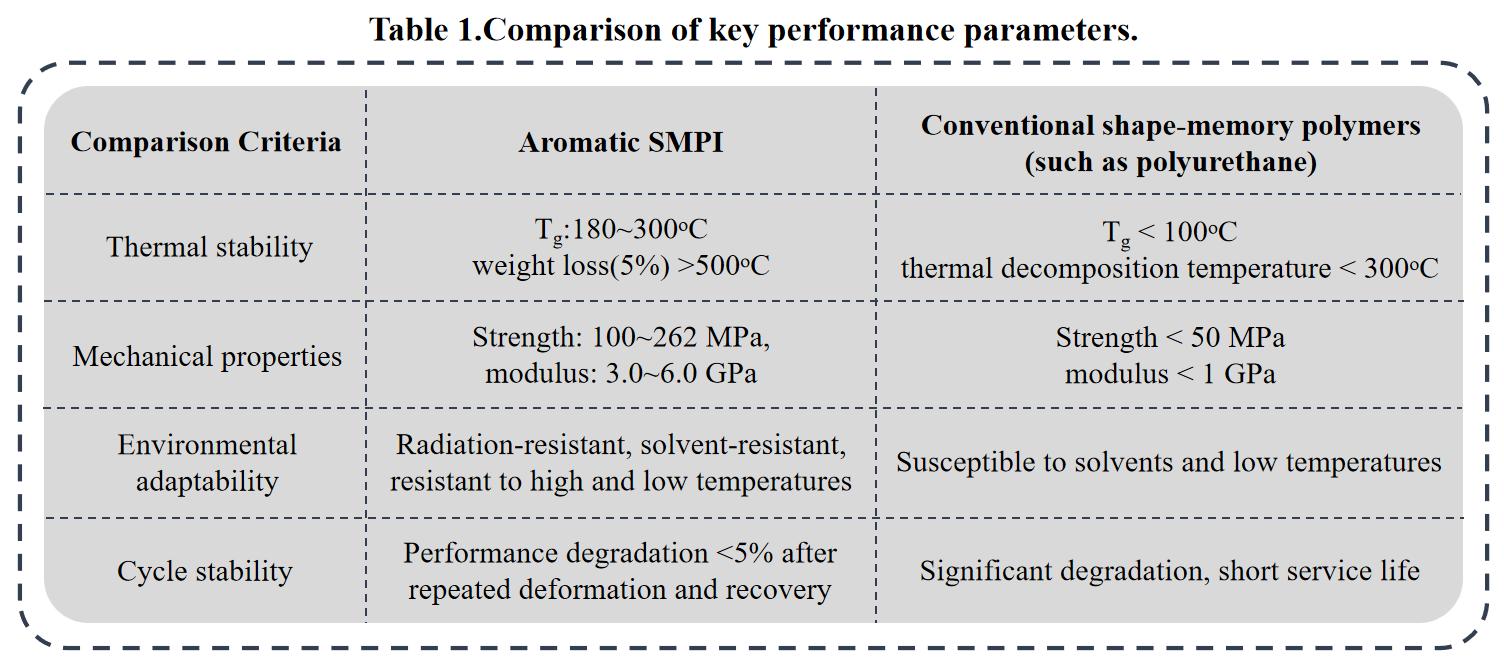
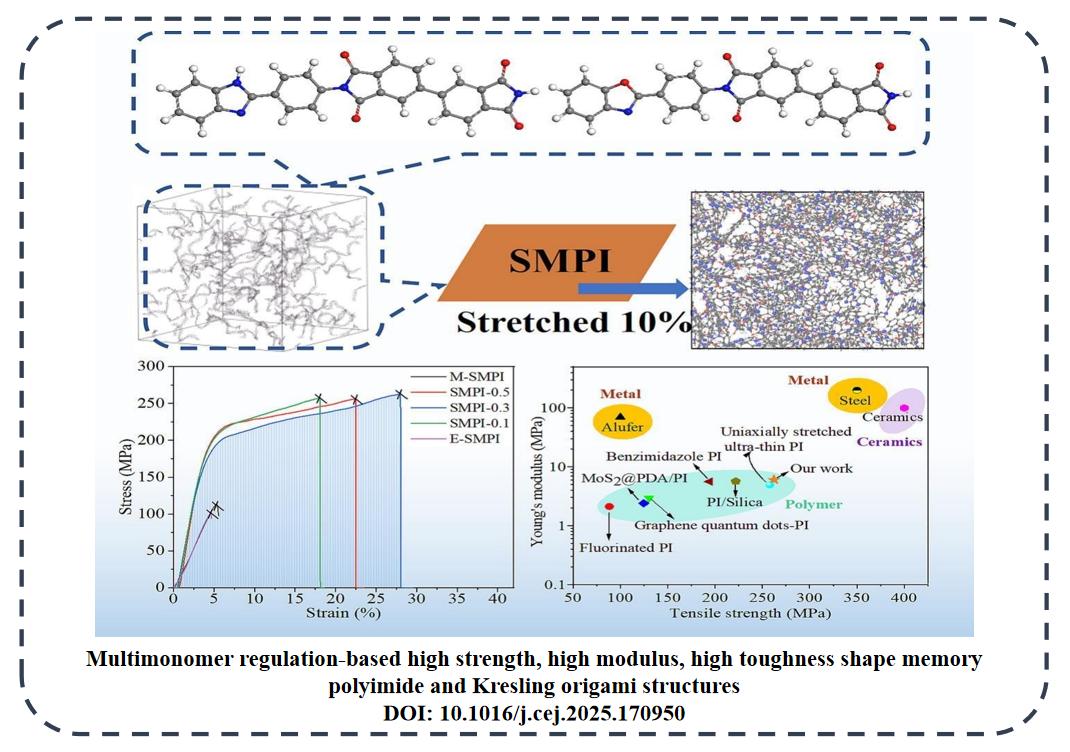
Aromatic polyimide products with an initial permanent shape can be deformed by external force and cooled to fix them into a temporary shape. Upon exposure to external stimuli such as heat, electricity, or light, they can autonomously return to their initial permanent shape, with both shape retention and recovery rates of ≥95%, while maintaining the high-temperature stability and mechanical strength characteristic of polyimide. Unlike conventional SMP, the rigid and reversible phases of Aromatic SMPI are dominated by aromatic rigid structures, resulting in a more stable mechanism.
Based on molecular structure and cross-linking methods, Aromatic SMPI is primarily classified into two major categories: thermoplastic and thermosetting. Thermoplastic systems are formed by copolymerizing rigid aromatic segments with flexible chain segments; they contain no chemical cross-links and can undergo remolding processes such as melt processing and 3D printing. They offer a wide adjustable range of glass transition temperatures and are highly versatile. Thermosetting systems form a three-dimensional network structure through chemical cross-linking, exhibiting superior high-temperature dimensional stability and higher modulus and strength, but are difficult to process further after molding. Based on their response mechanisms, they can be further classified into thermally responsive, electrically responsive, photoresponsive, and magnetically responsive types. Among these, thermally responsive systems are the most mature and widely used. Electrically responsive systems utilize conductive fillers to generate Joule heating, while magnetically responsive systems rely on heat generated by magnetic nanoparticles in an alternating magnetic field, making them suitable for applications in non-contact, remote, or enclosed environments.
Thanks to its comprehensive performance advantages, Aromatic SMPI is primarily used in applications with extremely high requirements for temperature resistance, strength, and reliability:
Aerospace (Core Application Areas): Used in deployable structures such as solar panels, antennas, and satellite sunshields, which are folded during launch and deployed via heating or electrical actuation after entering orbit; these components are lightweight and resistant to high temperatures. It is also used in smart skin adaptive wings and variable-geometry tail surfaces, maintaining their shape under high temperatures to improve flight efficiency; Used in shape-memory seals and thermal control louvers to automatically regulate temperature and adapt to extreme temperature fluctuations in space.
Semiconductors and Electronic Equipment: Serves as a high-temperature packaging material for chip packaging substrates and wafer trays, capable of long-term operation at 260oC, resistant to high soldering temperatures, and offering excellent dimensional stability; used in deformable flexible circuit boards and sensor housings, resistant to high-temperature bending, and suitable for 5G and flexible display devices; Used in precision components such as high-temperature connectors and insulating brackets, offering resistance to solvents and radiation while meeting the cleanliness requirements of semiconductor manufacturing.
High-End Equipment and Industry: In the automotive sector, it serves as engine compartment seals and smart bumpers, maintaining shape under high temperatures while being oil- and corrosion-resistant; in the medical device sector, it is used for high-temperature sterilization components and interventional medical stents (thermoresponsive), withstanding thousands of sterilization cycles and exhibiting excellent biocompatibility; in the energy sector, it is applied to new energy battery separators and thermal protection materials, offering high-temperature resistance and resistance to electrolyte corrosion.
Despite its excellent performance, Aromatic SMPI still has certain limitations. Current research and development efforts are primarily focused on developing eco-friendly synthesis processes to reduce monomer and production costs and facilitate commercialization in civilian applications; integrating self-healing, sensing, and conductive functions to achieve an integrated “sensing-actuation-repair” system; continuously optimizing the proportion of flexible segments to enhance toughness for use in flexible robots and wearable devices; and addressing processing precision issues to advance the large-scale application of processes such as 3D printing and injection molding.

HEYNOVA
an excellent service provider of key new materials and overall solutions for the global high-tech industry, focusing on the R&D and production of Polyimide monomer, Photoresist monomer & PAG, OLED monomer, Lithium battery materials, and customized services.


 English
 Nederland


-new-material-technology-co.,-ltd.-wechat.webp)