Color filters (CF) are the core components that enable color display in LCD panels, OLEDs, and image sensors, while photoresist is the most critical functional material used in their manufacture. Four main types of photoresists are used in the color filter manufacturing process: black matrix photoresist forms the grid between pixels, serving to block light, prevent crosstalk, and enhance contrast; color photoresists—specifically red (R), green (G), and blue (B)—are photosensitive, colored photoresists that determine the displayed colors, color gamut, and brightness; they represent the highest cost component and present the greatest technical challenge in CF production; White photoresist enhances brightness, ensures uniform light distribution, and improves backlight utilization; it is commonly used in high-brightness, energy-efficient display panels; protective layer photoresist is a colorless, transparent photoresist used to level the surface, protect RGB pixels, and shield them from damage during subsequent processes.
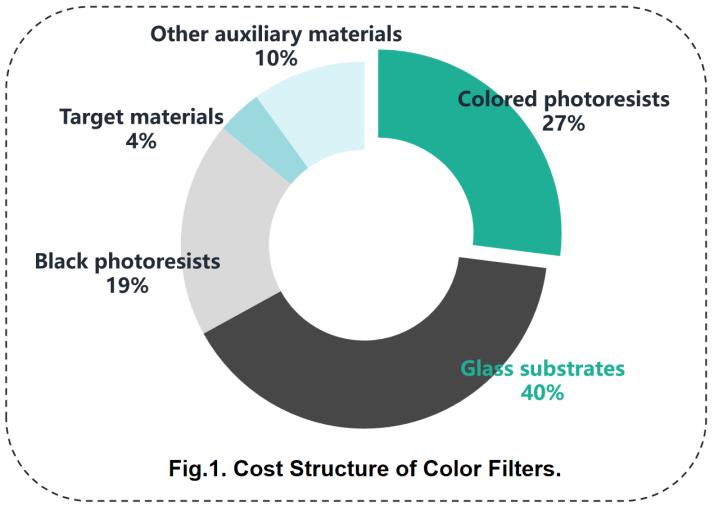
Color photoresist, formally known as photosensitive coloring resin for color filters, is also commonly referred to as RGB photoresist or CF photoresist. It is a high-end specialty chemical material that combines both photolithographic imaging capabilities and color-filtering functions, and it is the most critical material in the production of color filters, presenting the highest technical barriers. Not only can it achieve micron-level fine patterning through photolithographic processes such as exposure and development, but it can also selectively transmit red, green, or blue light while absorbing light in other wavelength bands. Combining optical, photolithographic, and structural film-forming functions, it plays a central role in forming the red, green, and blue primary-color pixels in color display panels. It directly determines the display panel’s color gamut, brightness, color purity, resolution, and long-term reliability, accounting for 25% to 30% of the cost structure of color filters.
In terms of product classification, color photoresists are most commonly categorized by color into red, green, and blue photoresists; a complete color filter manufacturing process requires the sequential use of these three types of photoresists. Chemically, color photoresists primarily consist of five major components: the coloring system, alkali-soluble resin, photosensitive system, solvent system, and various additives.
Coloring System: Primarily consists of nano-scale pigment dispersions. High-chromaticity, high-weatherability organic pigments are commonly used; for example, pyrrolo[3,4-b]pyridone and anthraquinone pigments are used for red, halogenated phthalocyanine green is used for green, and phthalocyanine blue for blue. Particle size must be controlled below 30~50 nm, with uniform dispersion and no agglomeration or sedimentation.
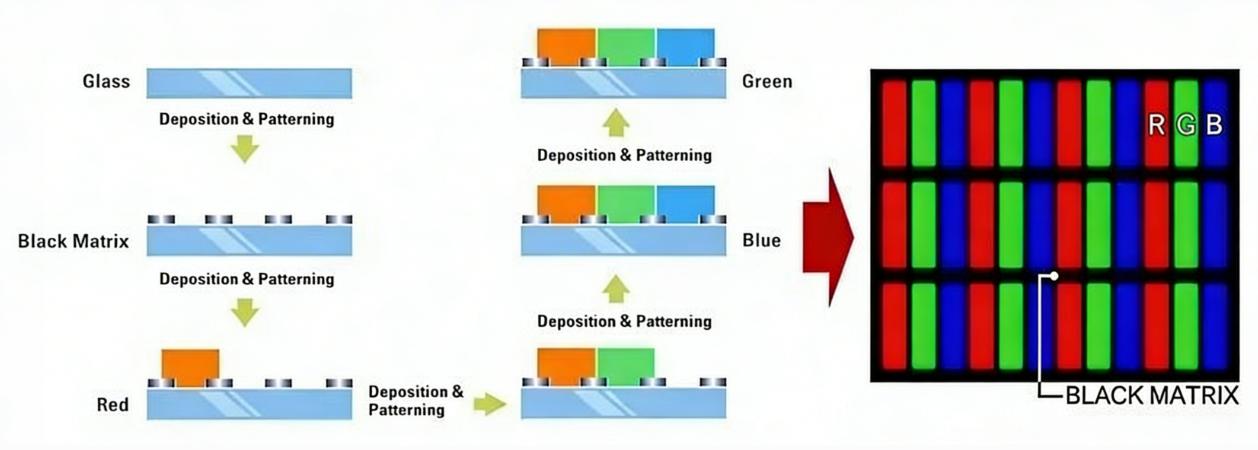
Alkali-soluble resins: These are primarily acrylic copolymers or phenolic resins that serve as matrix materials, providing film-forming properties, adhesion, hardness, and heat resistance, while ensuring proper development under mild alkaline conditions.
Photosensitive system: This includes photoinitiators, crosslinking monomers, or photosensitive acid-generating agents that produce reactive species upon exposure to ultraviolet light, triggering crosslinking or decomposition reactions to achieve patterning.
Solvent System: Primarily composed of compounds such as methyl acetate of propylene glycol, this system is used to adjust the viscosity of the resin solution, adapt to spin-coating or slot-dispensing processes, and control the evaporation rate to ensure a uniform film.
Additives: The system also includes dispersants, leveling agents, defoamers, and adhesion promoters to enhance pigment dispersion stability, film surface smoothness, and process compatibility.
Compared to semiconductor photoresists, colored photoresists exhibit significant differences in functional and performance requirements. Semiconductor photoresists aim for ultra-high-precision pattern transfer, featuring ultra-thin films and extremely high purity; in contrast, colored photoresists emphasize both optical and photolithographic performance, with thicker films and extremely stringent requirements for color purity, light transmittance, heat resistance, light resistance, and dispersion stability. In terms of key performance indicators, color photoresists must possess high color purity, high light transmittance, wide color gamut coverage, high resolution, and excellent pattern verticality. They must also remain free of yellowing and shrinkage at high temperatures of 230~250oC, resist fading under prolonged light exposure, demonstrate good tolerance to various process chemicals, and have extremely low levels of ionic impurities to prevent panel contamination.
In the future, color photoresists will continue to evolve toward wider color gamuts, higher resolution, OLED-specific formulations, ultra-thin designs with low shrinkage, and green manufacturing processes. Meanwhile, achieving self-reliance and control over key upstream raw materials—such as pigments, dispersions, resins, and photoinitiators—will become a major industry trend. The overall market is expected to maintain steady growth alongside the penetration of new display technologies, making it one of the most promising areas in the display materials sector.

HEYNOVA
an excellent service provider of key new materials and overall solutions for the global high-tech industry, focusing on the R&D and production of Polyimide monomer, Photoresist monomer & PAG, OLED monomer, Lithium battery materials, and customized services.


 English
 Nederland


![2-Propenoic Acid, 2-Methyl-, 5-[3,3,3-Trifluoro-2-Hydroxy-2-(Trifluoromethyl)propyl] Bicyclo[2.2.1]hept-2-Yl Ester 617711-94-1 C15H18F6O3](/uploads/image/20250708/617711-94-1-china.webp "2-Propenoic Acid, 2-Methyl-, 5-[3,3,3-Trifluoro-2-Hydroxy-2-(Trifluoromethyl)propyl] Bicyclo[2.2.1]hept-2-Yl Ester 617711-94-1 C15H18F6O3")
![2-Propenoic acid,1-methyl-1-tricyclo [3.3.1.13,7]dec-1-ylethyl ester 300833-10-7 C16H24O2](/uploads/image/20260612/300833-10-7-c16h24o2-0.webp "2-Propenoic acid,1-methyl-1-tricyclo [3.3.1.13,7]dec-1-ylethyl ester 300833-10-7 C16H24O2")
![2-Propenoic Acid, 2-Methyl-, (Tricyclo[3.3.1.13,7]dec-2-Yloxy)methyl Ester 791611-93-3 C15H22O3](/uploads/image/20250708/791611-93-3-china.webp "2-Propenoic Acid, 2-Methyl-, (Tricyclo[3.3.1.13,7]dec-2-Yloxy)methyl Ester 791611-93-3 C15H22O3")
-new-material-technology-co.,-ltd.-wechat.webp)