Photosensitive polyimide (PSPI) combines the excellent heat resistance, mechanical properties, and electrical insulation of polyimide with photolithographic patterning capabilities. By introducing photosensitive groups, the material can be directly patterned during the exposure—develop—cure process to form patterns directly and permanently retain them as functional layers, eliminating the dry etching process required for traditional non-photosensitive polyimide and improving patterning accuracy and yield. PSPI is a key photolithographic medium in the fields of advanced semiconductor packaging and OLED displays. It is widely used in advanced semiconductor packaging structures such as wafer passivation layers, stress relief layers, and redistribution layers (RDLs), as well as in the pixel definition layer (PDL) and planarization layer of OLED displays.
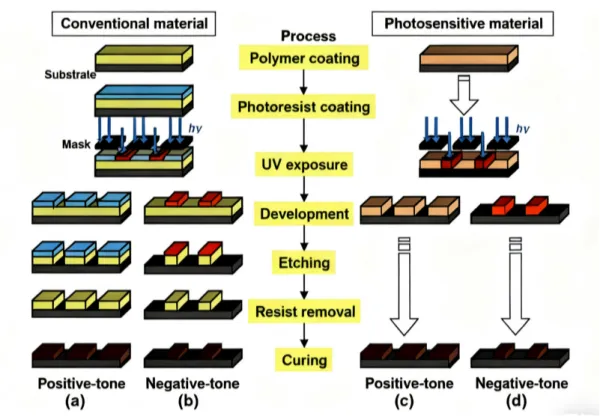
Classification and Photoresist Mechanism of PSPIs
Based on the polarity of photolithographic imaging, PSPIs are divided into two major categories: negative-type (n-PSPIs, where cross-links are retained in the exposed areas) and positive-type (p-PSPIs, where cross-links are dissolved and removed in the exposed areas); each category is further subdivided into self-photosensitive and externally photosensitized types based on the source of the photosensitive groups.
Negative Photoresist Polyimides (n-PSPIs)
1. Self-photosensitizing n-PSPIs: The photosensitive groups are chemically bonded to the polyamidoic acid (PAA)/PI molecular chains, eliminating the need for large amounts of external photoinitiators. The most typical example is polyamidoic acid grafted with methacrylate side groups, which contains unsaturated double bonds on the chain sides. Upon UV exposure, radical cross-linking occurs, forming an insoluble network in the exposed areas; after thermal imidization, a PI pattern is obtained. This system offers high resolution but has limited storage stability and significant cross-linking shrinkage; it was initially used by Japanese companies as a passivation layer material.
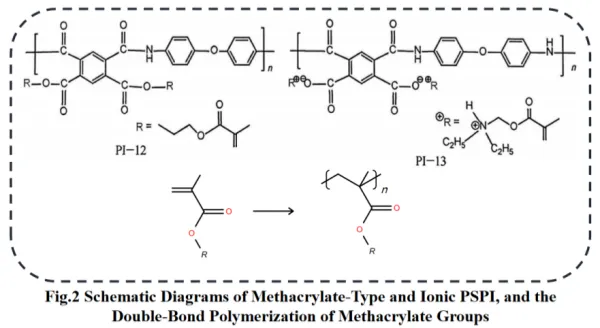
2. Externally added photoinitiator-based n-PSPIs: These are further divided into two categories. The first is the methacrylate type—with PAA as the matrix, to which acrylate active monomers and photoinitiators are added. After exposure, radical polymerization and cross-linking occur. This is the earliest commercialized and most technically mature negative-type process; however, small-molecule migration can easily cause pattern distortion and metal contamination; The second is the chemically amplified type—which incorporates a photoacid generator (PAG). The acid generated during exposure catalyzes the cross-linking reaction, amplifying the photoresist signal and significantly reducing the required exposure dose. This method is suitable for thick-film lithography but requires strict control of ionic impurities.
Positive-type photosensitive polyimides (p-PSPIs)
1. Self-sensitizing p-PSPIs: o-Nitrobenzyl ester type—an o-nitrobenzyl ester group is bonded to the PAA side chain; UV irradiation causes photolysis to generate carboxyl groups, increasing alkali solubility in the exposed areas to form a positive pattern. There is minimal small-molecule leaching, but photosensitivity is relatively low; Intrinsic DNQ type—Diazotized naphthoquinone (DNQ) is chemically bonded to the polymer backbone rather than physically blended, preventing small-molecule migration; however, synthesis is complex and costly.
2. Chemically amplified p-PSPIs: These rely on PAG exposure to generate acid, which catalyzes the hydrolysis or chain scission of polymer segments, amplifying the photochemical reaction. They require low exposure energy and offer high sensitivity; however, they are sensitive to alkaline impurities in the environment, have a narrow process window, and are still in the industrial optimization phase.
3. Externally Added DNQ-Based p-PSPIs: The most widely used system in industrial applications, classified into three types based on the matrix: PAA+DNQ, PI+DNQ, and reaction-developable types. In unexposed areas, DNQ inhibits matrix dissolution; after exposure, DNQ photolyses to form indanecarboxylic acid, causing the exposed areas to dissolve in alkali. The PAA+DNQ system features a wide process window and high patterning accuracy; the PI+DNQ matrix is pre-imidized, offering superior thermal dimensional stability; the reaction-developable type relies on the chemical interaction between the exposure product and the matrix to control solubility, making it suitable for high-resolution thick-film patterns.
Monomer Selection
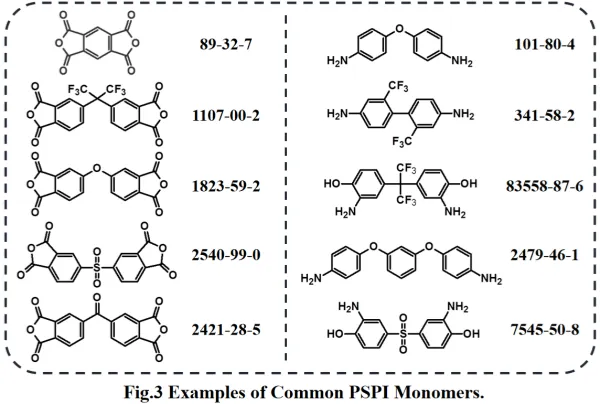
The PSPI matrix polymer is formed by the polycondensation of dianhydrides and diamines; the monomer structure directly determines the thermodynamic and electrical properties of the cured PI film. Commonly used dianhydrides include phthalic anhydride (PMDA), 3,3',4,4'-biphenyl tetracarboxylic anhydride (BPDA), 4,4'-oxybisphthalic anhydride (ODPA), and benzophenone tetracarboxylic anhydride (BTDA); Commonly used diamines include 4,4'-diaminodiphenyl ether (ODA) and p-phenylenediamine (PDA). Among these, the BPDA/PPD combination, due to its rigid main chain and low coefficient of thermal expansion (CTE), serves as the classic backbone for low-stress negative-type PSPIs; the PMDA/ODA system, with its wide processing window, is frequently used for passivation layers. In positive systems, o-nitrobenzyl groups are often introduced via side-chain esterification, or DNQ sulfonate is used as an external photosensitizer; diamines containing active carboxyl groups (such as 3,5-diaminobenzoic acid) can also be used as grafting anchor points.
HEYNOVA
an excellent service provider of key new materials and overall solutions for the global high-tech industry, focusing on the R&D and production of Polyimide monomer, Photoresist monomer & PAG, OLED monomer, Lithium battery materials, and customized services.


 English
 Nederland


-new-material-technology-co.,-ltd.-wechat.webp)