As semiconductor process nodes advance to 7 nm and below, the difficulty of fabricating nanoscale patterns has increased significantly due to the limitations of traditional DUV and EUV lithography—namely, the optical diffraction limit, random noise, and the high cost of multiple exposures. Directed self-assembly (DSA) lithography, a novel micro- and nanofabrication technology that combines top-down lithography with bottom-up molecular self-assembly, has become a core complementary process for advanced lithography due to its advantages of ultra-high resolution, low cost, and high pattern uniformity. It is widely used in the fabrication of high-density nanopatterns for logic and memory devices.
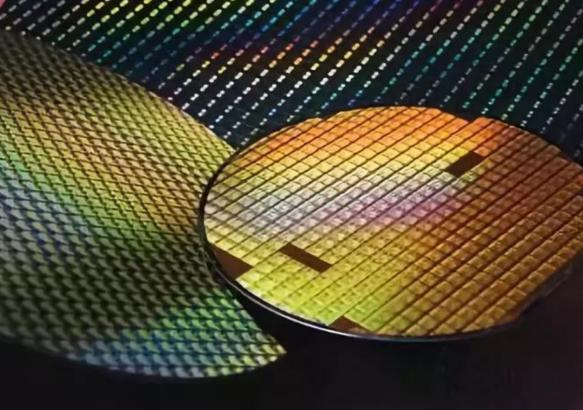
The core functional material for DSA lithography is a block copolymer (BCP), one of the advanced polymeric materials used for nanoscale pattern formation; the mainstream industrial system is PS-b-PMMA, in which the PS and PMMA polymer segments are linked end-to-end with clearly defined phase boundaries, exhibiting typical microphase-separation characteristics. Driven by thermodynamic forces, the incompatible polymer segments spontaneously form uniformly sized layered, columnar, or point-like nano-ordered structures, with pattern dimensions determined by the length of the molecular segments, thereby overcoming the wavelength limitations of traditional lithography. To address the issues of disorder and random orientation associated with unconstrained self-assembly, guidance mechanisms are introduced into the process to precisely control the position, orientation, and morphology of the nano-patterns, enabling the controlled fabrication of lithographic patterns.
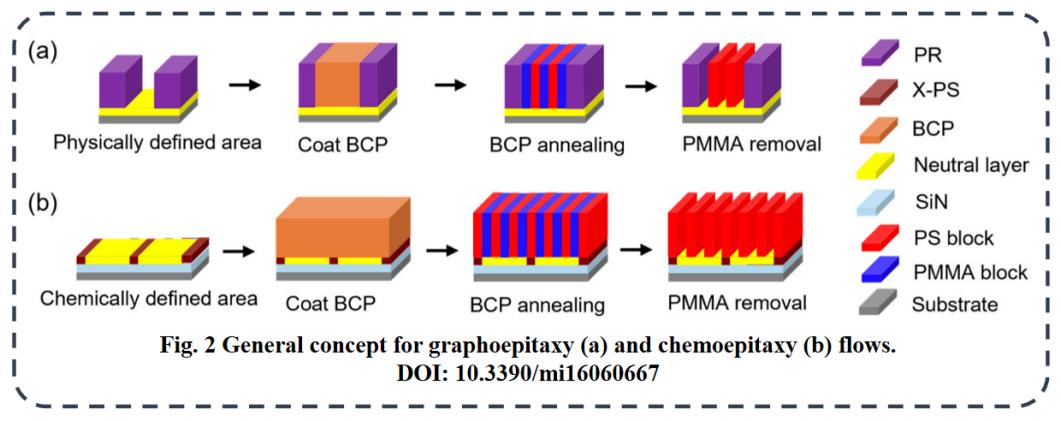
DSA lithography primarily involves two guidance mechanisms: patterned epitaxy and chemical epitaxy. Patterned epitaxy relies on topography-guided templates—such as grooves and holes—prefabricated via DUV or EUV lithography to physically constrain BCP phase separation. It is the mainstream approach for fabricating high-density contact holes and through-holes on chips, capable of generating multiple nanoscale holes within a single large-sized guide hole, thereby doubling pattern density and significantly replacing costly multiple-exposure processes. Chemical epitaxy, on the other hand, involves chemically modifying the substrate surface to create chemically partitioned regions with alternating hydrophilic and hydrophobic properties, thereby precisely controlling the orientation and arrangement of BCP domains. It is primarily used to fabricate nanowire grids with excellent uniformity, making it suitable for channel fabrication in advanced transistors such as FinFETs and GAAs.
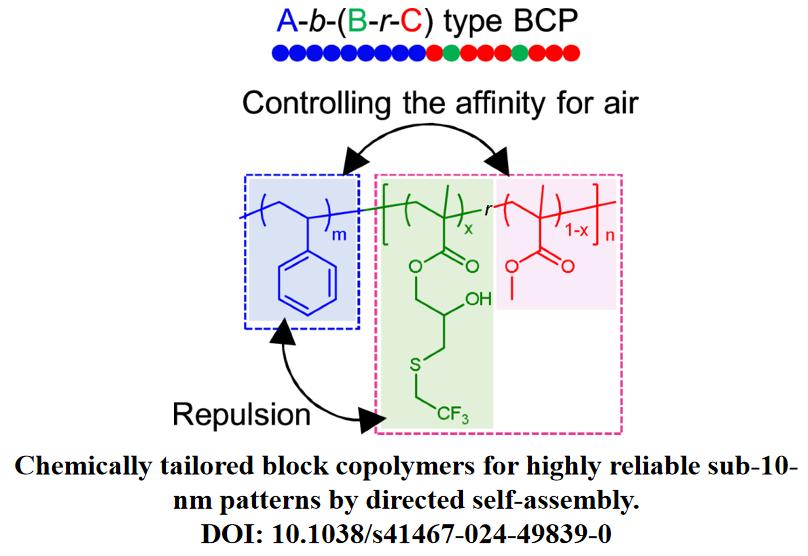
Interface control at the substrate is the key to high-quality DSA patterning, relying primarily on the neutral layer formed by the ternary random copolymer P(S-r-MMA-r-HEMA), in which the three monomers—S, MMA, and HEMA—are randomly distributed along the molecular backbone. This material serves a dual function of interface regulation and substrate anchoring. By adjusting the molar ratio of S to MMA, the interfacial energy between the substrate and the PS and PMMA phases can be balanced, creating a neutral surface that induces BCP domains to grow perpendicular to the substrate and prevents defects caused by parallel spreading. The hydroxyl groups carried by trace amounts of HEMA monomer can covalently graft and cross-link with the silicon substrate, forming a solvent-resistant, ultra-thin, dense underlayer with strong adhesion. This addresses the issues of incomplete grafting and numerous film defects associated with traditional random copolymers, ensuring uniform patterning across large-area wafers.
The complete DSA lithography process flow is well-established and compatible with existing semiconductor mass production lines. First, the substrate undergoes activation treatment, followed by spin-coating and curing of an HEMA-based neutral layer, and then rinsing to remove free polymers. Next, a guide template is fabricated via photolithography, a BCP film is spin-coated, and microphase separation is achieved through thermal annealing or solvent vapor annealing; Finally, selective etching removes the single-phase structure, transferring the self-assembled nanopatterns to the substrate to complete high-precision patterning. By adjusting the BCP molecular weight, monomer ratios, annealing parameters, and guide template dimensions, the process enables precise control over pattern period, aperture size, and line width, effectively mitigating random defects in EUV lithography such as edge roughness and size dispersion.
Compared to traditional lithography, DSA lithography can significantly reduce the number of masks, simplify the process flow, lower production costs, and achieve superior pattern size uniformity. However, this technology still faces industrialization bottlenecks, primarily including the difficulty in completely eliminating self-assembly-induced voids and bridging defects, the narrow process window for high-resolution, high-χ BCP materials, and the lack of sophisticated simulation and correction tools and in-line measurement equipment compatible with DSA, all of which limit further improvements in process yield. In the future, with the iteration of new BCP materials, the optimization of neutral layer modification technologies, and the refinement of defect control processes, DSA lithography will integrate deeply with EUV, further expanding the process boundaries of super-resolution lithography. It will become a core auxiliary process for advanced nodes of 5 nm and below, supporting the development of ultra-high-density integrated circuits and new micro- and nano-devices.
HEYNOVA
an excellent service provider of key new materials and overall solutions for the global high-tech industry, focusing on the R&D and production of Polyimide monomer, Photoresist monomer & PAG, OLED monomer, Lithium battery materials, and customized services.


 English
 Nederland



-new-material-technology-co.,-ltd.-wechat.webp)