Methacrylate-functionalized polyimide (MA-PI) is a class of special polyimide materials in which methacrylate groups (-OCOC(CH3)=CH2) are chemically incorporated into the main chain, side chains, or terminal ends of the polyimide molecular chain. These materials combine the excellent heat resistance and mechanical strength inherent to polyimides with the photosensitivity and cross-linkable properties of methacrylate groups, making them typical reactive, photosensitive, cross-linkable polyimides.
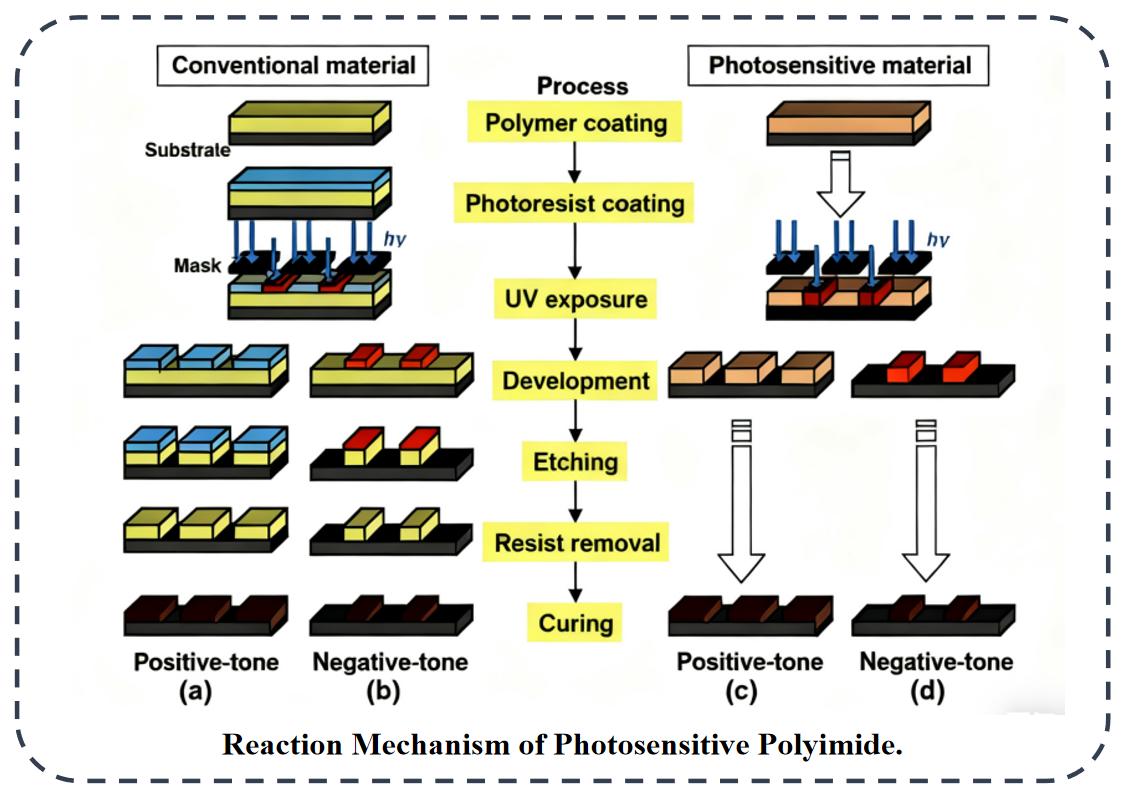
The core cross-linking mechanism of MA-PI is based on radical polymerization reactions. Depending on differences in chemical structure and grafting sites, MA-PI can be broadly classified into three major categories: side-chain type, terminal-capped type, and main-chain copolymer type. Different structural types correspond to distinct synthetic pathways and application areas. The mainstream synthetic routes for MA-PI are centered around different reaction sites and process requirements, offering a diverse range of technical options. Currently, the mainstream synthetic methods for MA-PI are as follows:
Esterification reaction between hydroxyl-containing polyimide (PI-OH) and methacrylic anhydride (MAH)
Epoxidation ring-opening reaction between hydroxyl-containing polyimide (PI-OH) and glycidyl methacrylate (GMA) (classic photoreactive PI route)
End-amine polyimide (PI-NH2) and methacrylic anhydride (MAH) end-capping reaction
Grafting followed by imidization of polyacamic acid (PAA-OH)
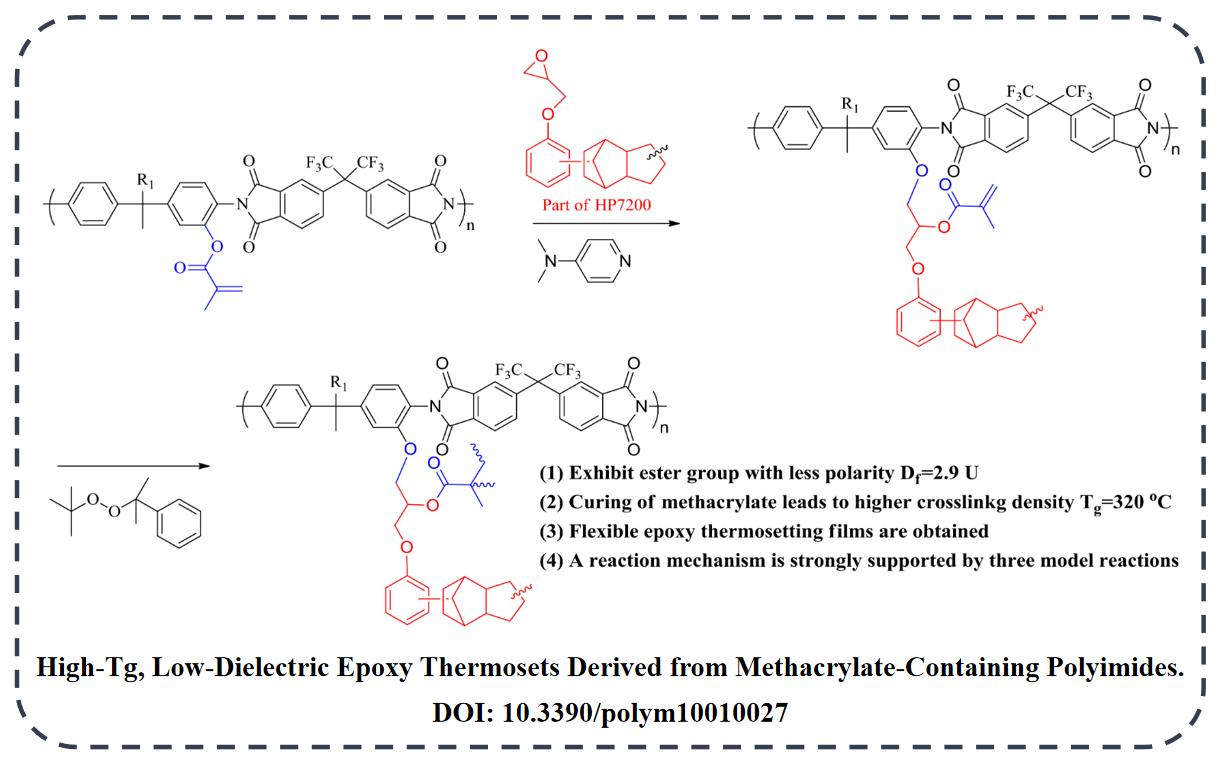
MA-PI offers excellent key performance characteristics that can be flexibly adjusted through formulation and processing, making it suitable for a wide range of applications. In terms of thermal properties, its Td(5%) is generally higher than 450oC, and its glass transition temperature (Tg) ranges from 220 to 300oC. Increasing the crosslinking density slightly improves the glass transition temperature and thermal stability, while residual solvents significantly reduce the material’s heat resistance; therefore, residual solvents must be removed through a rigorous vacuum post-curing process. In terms of photosensitivity, MA-PI is suitable for exposure wavelengths between 365 and 405 nm, with a photosensitivity of 100~500 mJ/cm2. Pattern resolution can reach 5~20 μm. The concentration of the photoinitiator and the ratio with the reactive diluent are the key factors influencing exposure speed and development contrast. In terms of mechanical and dielectric properties, MA-PI films exhibit tensile strengths exceeding 100 MPa and elongation at break ranging from 10% to 30%. With a dielectric constant of 3.0~3.5 at 1 MHz, they demonstrate excellent insulation properties, fully meeting the insulation requirements for microelectronic devices.
Thanks to its comprehensive performance advantages, MA-PI has typical and widespread applications across multiple high-end manufacturing sectors. In microelectronics packaging, as a photosensitive polyimide, it can be directly used as a wafer passivation layer, interlayer dielectric, and bump protective coating, enabling self-patterning without the need for additional photoresists, thereby effectively simplifying the manufacturing process and improving product yield. In the field of flexible electronics, MA-PI is suitable for critical components such as flexible display substrates, OLED encapsulation films, and sensor coatings. Through photopolymerization processes, it can produce ultra-thin, uniform films ranging from 5 to 20 μm, meeting the demand for lightweight and thin flexible devices. In the fields of 3D printing and advanced manufacturing, MA-PI oligomers, when combined with photopolymer resins, can be used in SLA/DLP photopolymerization 3D printing to produce high-temperature-resistant, self-lubricating aerospace structural components, such as lightweight bearings and other precision parts. Furthermore, when side-chain MA-PI is combined with an aluminum oxide sol, it can be used in electrophoretic deposition processes to produce thick insulating coatings of 100~150 μm, which are applied for insulation protection in electrical equipment such as motor stators and high-voltage devices.
To further enhance the processing stability and performance of MA-PI, process optimization should focus on key steps such as solvents, photoinitiators, and post-curing. For the solvent system, a blend of NMP and a small amount of ethanol is preferred, as it ensures good solubility and film-forming properties while avoiding interference with the esterification reaction caused by solvents containing reactive hydrogen. For thick-film systems exceeding 20 μm in thickness, it is recommended to use low-migration photoinitiators to effectively suppress yellowing and ensure optical and aesthetic performance. For the post-curing process following development, a stepwise temperature ramping mode is recommended to fully eliminate residual internal stress in the material, while further enhancing heat resistance and structural stability, thereby maximizing the material properties of MA-PI.
HEYNOVA
an excellent service provider of key new materials and overall solutions for the global high-tech industry, focusing on the R&D and production of Polyimide monomer, Photoresist monomer & PAG, OLED monomer, Lithium battery materials, and customized services.


 English
 Nederland


![2-Propenoic Acid, 2-Methyl-, 2-[(Hexahydro-2,2-Dioxido-3,5-Methanocyclopent[d]-1,2-Oxathiol-6-Yl)oxy]-2-Oxoethyl Ester 1135824-87-1 C13H16O7S](/uploads/image/20250708/1135824-87-1-china.webp "2-Propenoic Acid, 2-Methyl-, 2-[(Hexahydro-2,2-Dioxido-3,5-Methanocyclopent[d]-1,2-Oxathiol-6-Yl)oxy]-2-Oxoethyl Ester 1135824-87-1 C13H16O7S")
-new-material-technology-co.,-ltd.-wechat.webp)