Photoresist typically consists of a mixture of a resin base material, a photoacid generator, and various trace additives. Currently, conventional high-resolution photoresists employ chemically amplified photoresists.“Chemical amplification” refers to the process where the photoacid generator (PAG) decomposes upon exposure to light, producing acids. These acids trigger a series of chemical reactions, causing a significant change in the solubility of the photoresist material between the exposed and unexposed regions. Pattern transfer is then achieved through development. This process greatly enhances the sensitivity of photoresist. As feature sizes shrink, a corresponding reduction in molecular size becomes inevitable. However, traditional photoresist base materials employ polymer resins with molecular weights ranging from 5,000 to 15,000 Daltons. These polymer resins often compromise pattern resolution and edge roughness due to large molecular volume, molecular weight dispersion, and chain entanglement, failing to meet the demands of finer resolution requirements.

Monomolecular resin photoresists, also known as molecular glass photoresist (MG PR), serves as a core material for advanced extreme ultraviolet (EUV, 13.5 nm) and electron beam lithography (EBL). Its low molecular weight and precisely monodisperse structure overcome the chain entanglement and acid diffusion bottlenecks inherent in traditional polymer photoresists.
Molecular glass photoresist is not polymeric in nature but consists of precisely structured, monodisperse low-molecular-weight organic compounds that form stable amorphous films (exhibiting molecular glass characteristics). With typical molecular weights ranging from 500 to 3000 Daltons and a distinct glass transition temperature (Tg), it combines the structural controllability of small molecules with the film-forming properties of polymers. Their cores typically feature rigid skeletons (e.g., triphenylene, adamantane, tetraphenyl heterocycles, cuprophane) with peripheral polar/protective groups (e.g., hydroxyl, ester, epoxy, sulfonate) and some directly bonded acid-generating groups. Based on their topological structures, they can be categorized into three types: - Branched/star-shaped (e.g., triphenyl cores, adamantane multi-arms, tetraphenyl furan/pyrrole); - Cyclic (e.g., cuprophanes, cyclodextrin derivatives); - Functionalized frameworks (e.g., bisphenol A, triphenylene, sulfonate-functionalized).
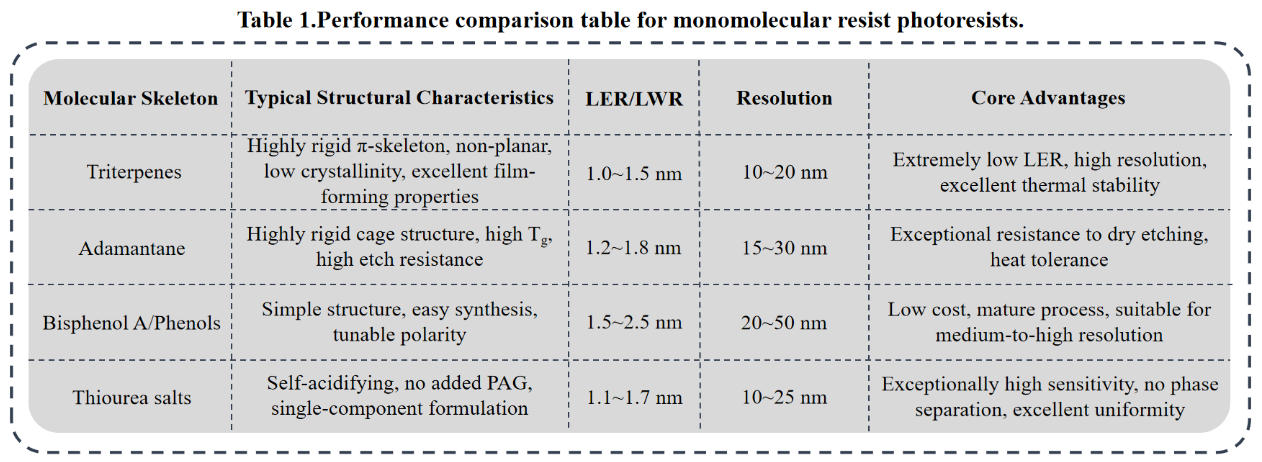
Compared to traditional high-molecular-weight resin photoresists, single-molecule resin photoresists offer distinct performance advantages: low line edge roughness (LER/LWR, EUV node requirement<1.5 nm), absence of polymer chain entanglement and crystallization defects; controllable acid diffusion with 10~20 nm resolution, suitable for 3 nm/2 nm advanced processes; well-defined molecular structures with excellent batch stability and controllable impurities; select molecules can directly bond PAG (e.g., sulfonate-type), simplifying formulations and reducing phase separation. However, sensitivity in pure monomolecular systems often requires optimization, such as high Tg and etch resistance dependent on backbone design, while large-scale synthesis poses greater challenges in purity and cost control compared to mature polymer resists.
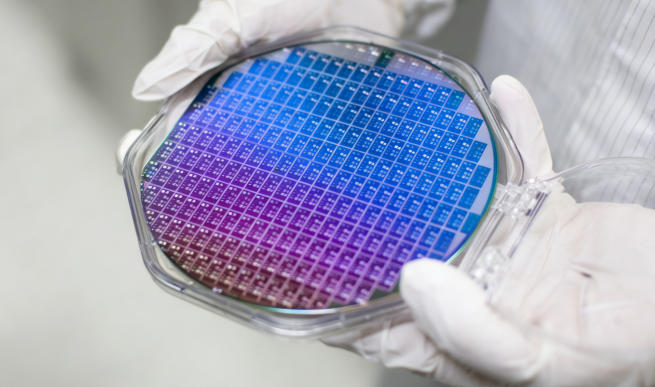
Monomolecular resin photoresists, with core advantages including high resolution, low LER/LWR, controllable acid diffusion, and precise structure, serve as the core material for EUV/electron beam advanced lithography. They are primarily applied in ultra-high-precision micro/nanofabrication scenarios. The finer, more advanced, and more cutting-edge the micro/nanofabrication, the greater the need for monomolecular resin photoresists.
· Advanced Semiconductor Chips: Achieves low roughness and high resolution for the most intricate patterning in 7/5/3/2 nm advanced logic chips, high-end DRAM, and 3D NAND.
· Lithography Masks & Nanoimprint Masters: Directly written via electron beam to create EUV masks and nanoimprint templates—the“master materials”for high-end chip manufacturing.
· High-End Displays: Precision patterning for ultra-high-resolution, small-pixel display panels like Micro-OLED and Micro-LED.
· Optoelectronics & Quantum Devices: Fabrication of nanoscale structures for silicon photonic chips, waveguides, gratings, MEMS, sensors, and quantum devices.
HEYNOVA
an excellent service provider of key new materials and overall solutions for the global high-tech industry, focusing on the R&D and production of Polyimide monomer, Photoresist monomer & PAG, OLED monomer, Lithium battery materials, and customized services.


 English
 Nederland


-new-material-technology-co.,-ltd.-wechat.webp)