Photoresist monomers are the core raw materials forming the backbone of photoresist resins. Their molecular structures determine key properties such as light transmittance, etch resistance, and acid sensitivity, adapting to different light source wavelengths and process requirements.
G-line/I-line Photoresists (436 nm/365 nm)
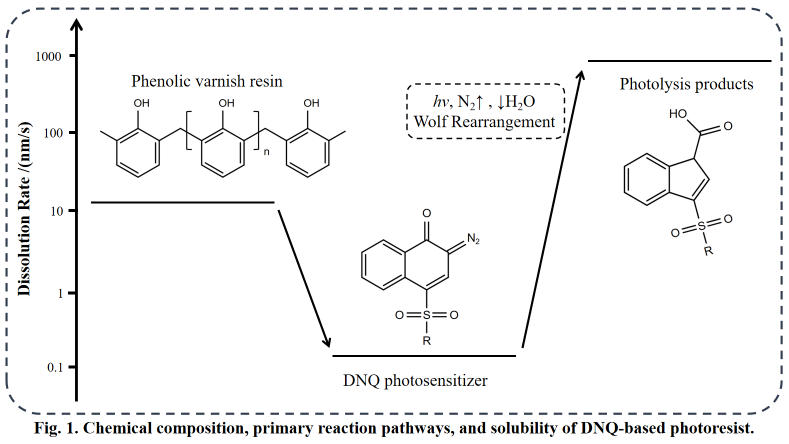
G-line/I-line photoresists primarily utilize positive-type systems (DNQ system). The resin is a phenolic resin polymerized from phenol and aldehyde monomers, with diazonaphthoquinone (DNQ) as the photosensitizer. Negative-type systems predominantly employ cycloalkene rubber monomers. Resolution is optimized by adjusting the ratio of cresol isomers, while biphenyl monomers enhance etch resistance, making them suitable for mature processes ≥0.35 μm. Core monomers include:
Phenolic Monomers: o-Cresol, p-Cresol, m-Cresol, Bisphenol A, etc., providing alkali solubility and etch resistance. Development rate is controlled by adjusting the ratio of phenolic hydroxyl groups.
Aldehyde monomers: Formaldehyde (polyformaldehyde), furfural. These polymerize with phenols to form linear phenolic resins, where the backbone structure determines thermal stability and adhesion.
Negative-type monomers: Cyclopentadiene, polybutadiene, combined with crosslinking agents (e.g., bisazide compounds) to achieve photopolymerization, forming an insoluble crosslinked network structure.
KrF employs a chemically amplified (CAR) positive resist system. The resin core is poly(p-hydroxystyrene) (PHS), with monomers incorporating protective groups to regulate acid-catalyzed deprotection reactions, enhancing sensitivity and resolution. The steric hindrance of protective groups (e.g., tert-butyl) controls acid diffusion length, balancing sensitivity with linewidth uniformity to support 0.25 μm to 0.13 μm processes (mature nodes for DRAM/Flash and logic chips). Core monomers are as follows:
Main monomer: p-Hydroxystyrene, providing alkali solubility and high 248 nm transmittance, forming the resin backbone core.
Protective group monomers: 4-Vinylphenyl tert-butyl carbonate (PTBCS), tert-butoxycarbonyl-oxy-styrene. Deprotection post-exposure generates phenolic hydroxyl groups, enabling reversal of alkali-developable solubility.
Crosslinking Monomer: 4-Acetoxy-styrene (ACS), used in negative or thick resists. Crosslinking enhances etch resistance, enabling lift-off processes and high aspect ratio structures.
Modifying Monomers: Vinylnaphthalene and Styrene-Biphenyl, improving resin rigidity and etch selectivity while reducing line edge roughness (LER).
ArF Photoresist (193 nm, Dry/Immersion)
ArF photoresists require adaptation for 193 nm transmittance. Due to the strong absorption of phenolic systems, alicyclic acrylic/methacrylic monomers are employed to form polymethacrylate resins. These are modified with nitrile- and ester-functional monomers to meet dry/immersion process requirements. Core monomers are listed in the table below:
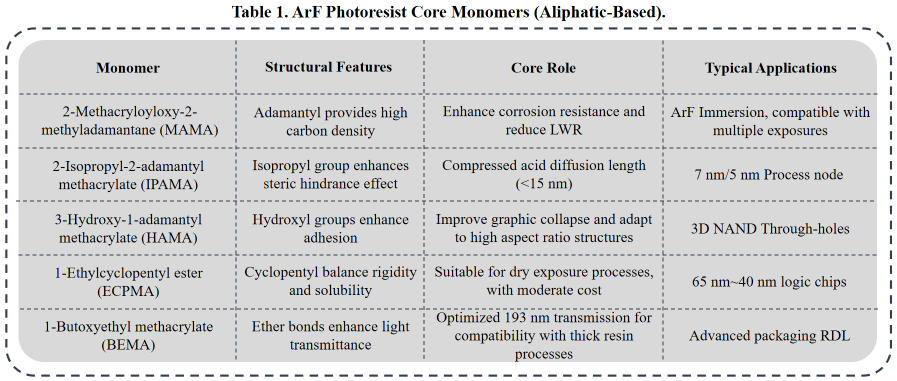
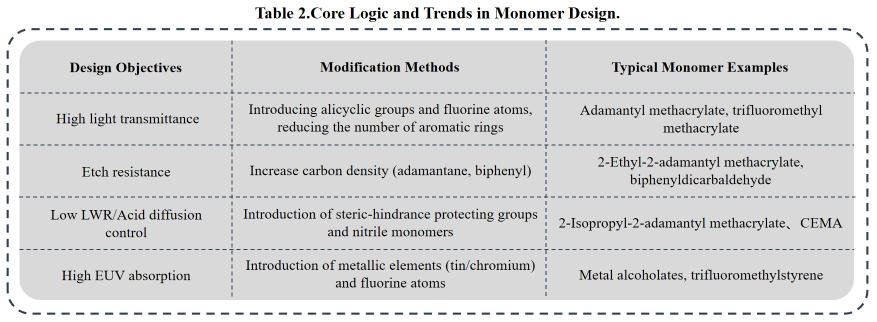
Additionally, modified monomers such as cyanoethyl methacrylate (CEMA) enhance substrate adhesion; norbornene derivatives elevate resin glass transition temperature (Tg); quenchers (e.g., trialkylamines) control acid diffusion, enabling adaptation to advanced 28 nm to 7 nm processes (in conjunction with multiple exposures).
EUV Photoresist (13.5 nm)
EUV photoresists require high EUV absorption efficiency, low defect density, and high resolution. Monomer systems are categorized into chemical amplification (CAR), molecular glass, and metal oxide types, tailored for 7 nm and below leading-edge processes. Core monomers include:
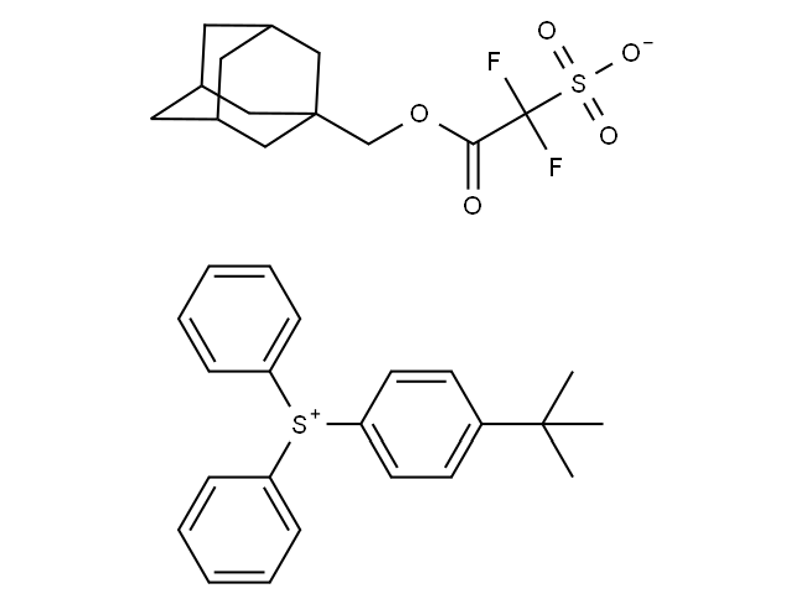
CAR System Monomers: Based on PHS derivatives (e.g., 4-hydroxy-styrene-trifluoromethylacrylate copolymer), incorporating fluorine atoms to enhance EUV absorption, with sulfonate-based PAGs added to boost sensitivity.
Molecular Glass Monomers: Small-molecule aromatic hydrocarbons containing hydroxyl/ester groups (e.g., 1,3-dihydroxyadamantane diacrylate). These form amorphous films with excellent uniformity, reduce light weight ratio (LWR), and meet ultra-high resolution requirements.
Metal Oxide Monomers: Metal alcoholates of tin, hafnium, zirconium, etc. (e.g., hafnium isopropylate) exhibit high EUV absorption cross-sections and strong etch resistance, suitable for ultra-fine line widths (3 nm/2 nm), though sensitivity requires improvement.
Photoresist monomers evolve with shorter light source wavelengths, transitioning from phenolic/styrene systems to alicyclic acrylates, molecular glasses, and metal-based systems. The core challenge lies in balancing transmittance, etch resistance, resolution, and process compatibility. Regarding domestic substitution, G-line/I-line monomers have achieved mass production, KrF monomers are undergoing validation, and ArF monomers (e.g., adamantyl esters) have made breakthroughs. EUV monomers remain the key focus for technological advancement.
HEYNOVA
an excellent service provider of key new materials and overall solutions for the global high-tech industry, focusing on the R&D and production of Polyimide monomer, Photoresist monomer & PAG, OLED monomer, Lithium battery materials, and customized services.


 English
 Nederland


![Iridium, (3,7-diethyl-4,6-nonanedionato-κO4,κO6)bis[2,4-dimethyl-6-[6-(1-methylethyl)-1-isoquinolinyl-κN]phenyl-κC]-1894218-56-4 C53H63IrN2O2](/uploads/image/20251017/1894218-56-4-china.webp "Iridium, (3,7-diethyl-4,6-nonanedionato-κO4,κO6)bis[2,4-dimethyl-6-[6-(1-methylethyl)-1-isoquinolinyl-κN]phenyl-κC]-1894218-56-4 C53H63IrN2O2")
-new-material-technology-co.,-ltd.-wechat.webp)