PMDA, or pyromellitic dianhydride, and 6FDA are aromatic dianhydrides used to build high-performance polyimides, but they solve different formulation problems. PMDA is usually the stronger starting point when a compact, rigid backbone and thermal or dimensional performance are central priorities. 6FDA is often selected when optical transparency, a lower dielectric tendency, or improved organosolubility and solution processing are more important.
Neither monomer is universally better. The diamine, molecular weight, stoichiometric balance, imidization route, curing profile and additives can change the result. Selection should begin with the application’s most important property and end with side-by-side testing of the intended formulations.
PMDA vs 6FDA at a Glance
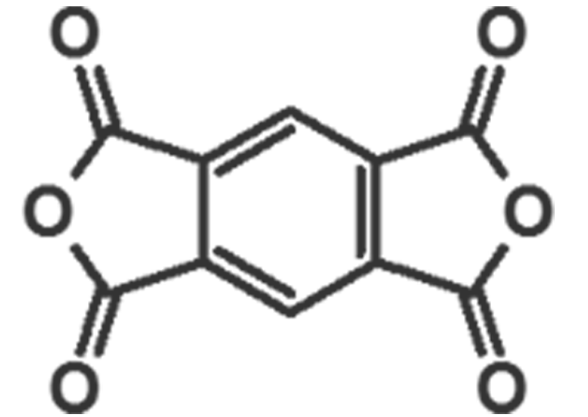
PMDA, or pyromellitic dianhydride, is a small, rigid dianhydride built around one aromatic ring. 6FDA contains two phthalic anhydride units separated by a bulky hexafluoroisopropylidene group. This structural difference changes how closely the resulting polymer chains can pack and interact.
| Comparison Point | PMDA | 6FDA |
| Full name | Pyromellitic dianhydride | 4,4′-(Hexafluoroisopropylidene)diphthalic anhydride |
| CAS number | 89-32-7 | 1107-00-2 |
| Molecular weight | 218.12 | 444.24 |
| Defining feature | Compact aromatic unit | Bulky –C(CF₃)₂– bridge |
| Common design direction | Thermal and dimensional performance | Transparency, lower dielectric tendency and greater solubility |
| Key point to verify | Color and processing route | Thermomechanical balance |
These are design tendencies rather than guaranteed specifications. A flexible diamine can change the behavior of a PMDA-based polymer, while a rigid diamine can give a 6FDA-based polymer substantial thermal performance. Buyers should compare complete polymer systems rather than judge a resin from the dianhydride alone.
How Molecular Structure Distinguishes PMDA from 6FDA
In pyromellitic dianhydride, the two anhydride functionalities are integrated into a compact aromatic structure. After polymerization and imidization, this architecture can produce rigid chain segments that pack efficiently. Restricted segmental movement is one reason PMDA is considered when heat resistance and dimensional control are important.
The 6FDA molecule is larger. Its two aromatic anhydride units are connected through a carbon bearing two trifluoromethyl groups. This bulky group interrupts close packing and introduces free volume into many resulting polyimides. The electron-withdrawing fluorinated structure can also weaken charge-transfer interactions that commonly create yellow or amber color in fully aromatic polyimide films.
PMDA therefore tends to emphasize compactness and rigidity, whereas 6FDA creates a less tightly packed, fluorinated backbone. The diamine remains the other half of the repeat unit and must be evaluated with equal care.
Thermal, Optical and Dielectric Trade-Offs in Polyimide Design
For thermal and dimensional requirements, PMDA is often a logical benchmark. Its rigid structure can support high glass-transition temperatures and good dimensional stability. These features can be valuable in electronic insulation, high-temperature films and components that must retain their geometry through repeated heating. They do not mean every PMDA formulation will outperform every 6FDA formulation; the diamine and curing conditions can narrow or reverse the difference.
The main attraction of 6FDA is its ability to change optical and electrical behavior without abandoning an aromatic polyimide backbone. By disrupting chain packing and reducing charge-transfer interactions, 6FDA frequently supports lighter-colored or more transparent films. Its fluorinated groups and added free volume can also reduce molecular polarizability per unit volume, which is favorable when a lower dielectric constant is targeted.
Qualification should therefore cover more than heat resistance. A transparent electronic film may require tests for glass-transition temperature, thermal decomposition, coefficient of thermal expansion, optical transmittance, haze, yellow index, dielectric constant and dielectric loss. Dielectric tests should use the intended operating frequency and humidity condition rather than relying on a single room-temperature value.
How Monomer Choice Affects Solubility, Processing and Final Resin Form
Many aromatic polyimides are processed first as poly(amic acid) solutions and then converted to the imide through thermal or chemical imidization. A PMDA-based system can fit this route, but the fully imidized polymer may be difficult to redissolve. That is acceptable for a film formed and cured in place, yet less convenient when processing requires a soluble, pre-imidized polyimide.
The bulky, non-coplanar structure introduced by 6FDA often improves organosolubility by preventing dense chain packing. This may support solution casting, coatings and other processes that benefit from a soluble final polymer. However, 6FDA does not guarantee solubility. Diamine structure, molecular weight, end groups, solvent choice and imidization degree all influence whether the final material remains processable.
If manufacturing begins with a ready-to-process polyimide resin powder, purchasing questions shift from monomer structure to grade-specific performance. Particle form, molding conditions, filler content, flow, thermal properties and final-part requirements must be checked for the actual grade. A monomer-level comparison cannot replace resin qualification.
When Should Buyers Choose PMDA or 6FDA?
Choose pyromellitic dianhydride when the formulation needs a rigid aromatic backbone and the leading targets are thermal endurance, dimensional stability or dependable electrical insulation. It is also a practical candidate when the established process uses a poly(amic acid) precursor followed by imidization and optical color is not the primary requirement.
Choose 6FDA when the application prioritizes a colorless or highly transparent film, lower dielectric behavior, potentially lower moisture uptake or better access to solution-processable polyimides. It can be relevant to optical and electronic materials where appearance and electrical performance must be balanced with heat resistance. The diamine and cure schedule must still be optimized.
A mixed-dianhydride route may be appropriate when neither endpoint provides the required balance. Adding 6FDA to a rigid system can improve transparency or solubility, while retaining PMDA can help preserve backbone rigidity. The optimum ratio must be established experimentally rather than selected from a generic formulation.
Before approving a supplier, request a lot-specific certificate of analysis and confirm chemical identity, assay method, purity, moisture control, relevant ionic or metal impurities, packaging and storage instructions. Moisture exposure can affect dianhydride quality and downstream polymerization. A sample should be evaluated with the intended diamine, solvent, solids content and cure profile before scale-up.
Frequently Asked Questions About PMDA and 6FDA
1. What does PMDA stand for?
PMDA stands for pyromellitic dianhydride, an aromatic tetracarboxylic dianhydride used to synthesize polyimides and other high-performance materials. Its CAS number is 89-32-7.
2. Is PMDA or 6FDA better for high-temperature polyimide?
PMDA is often preferred when rigidity and dimensional stability lead the specification, but 6FDA can also produce thermally stable polyimides. Compare polymers made with the same diamine under equivalent molecular-weight and curing conditions.
3. Which dianhydride is more suitable for transparent polyimide?
6FDA is generally the stronger starting point because its bulky fluorinated group can suppress close packing and charge-transfer interactions. Transparency still depends on the diamine, film thickness, residual solvent and imidization process.
4. Is 6FDA always better for a low-dielectric material?
No. 6FDA often supports a lower dielectric constant, but repeat-unit structure, free volume, moisture uptake, additives and measurement frequency all matter. Both dielectric constant and dielectric loss should be tested under relevant service conditions.
5. Can PMDA and 6FDA be used in the same formulation?
Yes. Copolyimide design can use both dianhydrides to tune transparency, solubility, thermal behavior and dimensional performance. The ratio affects polymerization and final properties, so it requires controlled comparative trials.
6. What should a buyer include in a dianhydride sample request?
Provide the target application, selected diamine, synthesis route, solvent system, solids content, cure conditions and critical performance limits. This helps the supplier provide the appropriate documentation and sample quantity for qualification.
HEYNOVA
an excellent service provider of key new materials and overall solutions for the global high-tech industry, focusing on the R&D and production of Polyimide monomer, Photoresist monomer & PAG, OLED monomer, Lithium battery materials, and customized services.


 English
 Nederland



-new-material-technology-co.,-ltd.-wechat.webp)